ABSTRACT
CO2 flooding for oil recovery is a dynamic process that requires further investigation of oil-gas interface change characteristics, interfacial mass transfer processes, and oil-gas composition variation during both immiscible and miscible displacement. Understanding these factors is crucial for better comprehending their impact on CO2-enhanced oil recovery (EOR). This research used a jointly developed CO2 miscible visual flooding experimental apparatus to study the horizontal dynamic characteristics of CO2 and crude oil under different pressures and flow rates in visual slim tube. At 10 MPa, the stratification results of CO2 and crude oil indicate that the experiment is immiscible flooding. The contact angle (7.9°) between the two phases of CO2 and crude oil at the flow rate of 15 cm/min is larger than that (5.2°) at 1.5 cm/min, and the grey scale of CO2 increases at 100 cm/min. The quantity, individual content, and shape of the light and medium hydrocarbon components condensed on the inner wall of the tube vary with different flow rates. At 15 MPa, the appearance of the CO2 and crude oil transition interval proves that the experiment is miscible flooding. At different flow rates, the inclination angle and distribution of black stripes vary. The whole transition interval is divided into 6 intervals, and the transition interval lengthens with increasing fluid velocity. The experiments visually demonstrate the occurrence of the miscible phase, and identify experimental pressure and fluid flow rate as key factors influencing the miscibility of CO2 and crude oil.
KEYWORDS:
CO2 and Crude Oil; Immiscible Flooding; Miscible Flooding; Dynamic Characteristics; Visual Slim Tube
RESUMEN
La inundación de CO2 para la recuperación de petróleo es un proceso dinámico que requiere más investigación sobre las características de cambio de la interfaz petróleo-gas, los procesos de transferencia de masa interfacial y la variación de la composición petróleo-gas durante el desplazamiento tanto inmiscible como miscible. Comprender estos factores es crucial para comprender mejor su impacto en la recuperación de petróleo mejorada con CO2 (EOR). Esta investigación adopta un aparato experimental de inundación visual miscible con CO2 desarrollado conjuntamente para estudiar las características dinámicas horizontales del CO2 y el petróleo crudo bajo diferentes presiones y caudales en un tubo visual delgado. A 10 MPa, los resultados de la estratificación del CO2 y del petróleo crudo indican que el experimento es una inundación inmiscible. El ángulo de contacto (7,9°) entre las dos fases de CO2 y el petróleo crudo a un caudal de 15 cm/min es mayor que el (5,2°) a 1,5 cm/ min, y la escala de grises del CO2 aumenta a 100 cm/min. La cantidad, el contenido individual y la forma de los componentes de hidrocarburos ligeros y medios condensados en la pared interior del tubo varían con diferentes caudales. A 15 MPa, la aparición del intervalo de transición de CO2 y petróleo crudo demuestra que el experimento es una inundación miscible. A diferentes caudales, el ángulo de inclinación y la distribución de las franjas negras son diferentes. Todo el intervalo de transición se divide en 6 intervalos y el intervalo de transición se alarga al aumentar la velocidad del fluido. Los experimentos demuestran visualmente la aparición de la fase miscible e identifican la presión experimental y el caudal de fluido como factores clave que influyen en la miscibilidad del CO2 y el petróleo crudo.
PALABRAS CLAVE:
CO2 y Petróleo Crudo; Inundaciones inmiscibles; Inundaciones miscibles; Características Dinámicas; Tubo visual Delgado
1. INTRODUCTION
CO2 flooding, a relatively mature technology, is also considered one of the most promising methods for Enhanced Oil Recovery (EOR) (Brattekås & Seright, 2023Brattekås, B., & Seright, R. (2023). A Review of Polymer Gel Utilization in Carbon Dioxide Flow Control at the Core and Field Scale. SPE Journal, 28(06), 3291-3307. https://doi.org/10.2118/217427-PA
https://doi.org/10.2118/217427-PA...
; Prakash et al., 2024Prakash, S., Joshi, D., Ojha, K., & Mandal, A. (2024). Enhanced Oil Recovery Using Polymer Alternating CO2 Gas Injection: Mechanisms, Efficiency, and Environmental Benefits. Energy & Fuels, 38(7). 5676-5689. https://doi.org/10.1021/acs.energyfuels.3c04258
https://doi.org/10.1021/acs.energyfuels....
; Xiao et al., 2023Xiao, W., Yang, Y., Bernabé, Y., Lei, Q., Li, M., Xie, Q.....Ren, J. (2023). Experimental Study on EOR in Shale Oil Cores during Associated Gasflooding: A Case Study from Yanchang Formation, Ordos Basin. SPE Journal, 28(05), 2329-2345. https://doi.org/10.2118/214704-PA
https://doi.org/10.2118/214704-PA...
). Currently there are hundreds of experimental projects and commercial projects of CO2 flooding in the world (Davoodi et al., 2024Davoodi, S., Al-Shargabi, M., Wood, D. A., Mehrad, M., & Rukavishnikov, V. S. (2024). Carbon dioxide sequestration through enhanced oil recovery: A review of storage mechanisms and technological applications. Fuel, 366, 131313. https://doi.org/10.1016/j.fuel.2024.131313
https://doi.org/10.1016/j.fuel.2024.1313...
; Li et al., 2022Li, L., Zhou, X., Su, Y., Xiao, P., Chen, Z., & Zheng, J. (2022). Influence of Heterogeneity and Fracture Conductivity on Supercritical CO2 Miscible Flooding Enhancing Oil Recovery and Gas Channeling in Tight Oil Reservoirs. Energy & Fuels, 36(15), 8199-8209. https://doi.org/10.1021/acs.energyfuels.2c01587
https://doi.org/10.1021/acs.energyfuels....
). For CO2 flooding in China, the scale effect has not yet formed. The main reasons are:. First, the content of paraffin, gum, and asphaltene in the crude oil of continental oil fields is high, and the minimum miscibility pressure is high. Second, heterogeneity is significant in continental sedimentation. Third, CO2 costs are too high due to scarce gas sources (Gür, 2022Gür, T. M. (2022). Carbon Dioxide Emissions, Capture, Storage and Utilization: Review of Materials, Processes and Technologies. Progress in Energy and Combustion Science, 89, 100965. https://doi.org/10.1016/j.pecs.2021.100965
https://doi.org/10.1016/j.pecs.2021.1009...
; Lin et al., 2024Lin, Z., Lu, X., Wang, X., Chang, Y., Kang, K., & Zeng, F. (2024). Effect of N2 impurity on CO2-based cyclic solvent injection process in enhancing heavy oil recovery and CO2 storage. Energy, 290, 130227. https://doi.org/10.1016/jenergy.2023.130227
https://doi.org/10.1016/jenergy.2023.130...
; Shen et al., 2022Shen, M., Tong, L., Yin, S., Liu, C., Wang, L., Feng, W., & Ding, Y. (2022). Cryogenic technology progress for CO2 capture under carbon neutrality goals: A review. Separation and Purification Technology, 299, 121734. https://doi.org/10.1016/j.seppur.2022.121734
https://doi.org/10.1016/j.seppur.2022.12...
). In the past few decades, CO2 EOR, as a continuously developing oil production technology, has conducted numerous laboratory tests, numerical simulations, and field practices to enhance oil recovery. These efforts include refining reservoir characterization, enhancing fluid flow control capabilities, and ensuring the consistency of the CO2 flooding front. CO2 EOR technology has been proven to increase oil recovery by 8% to 16% (Kumar et al., 2022Kumar, N., Augusto Sampaio, M., Ojha, K., Hoteit, H., & Mandal, A. (2022). Fundamental aspects, mechanisms and emerging possibilities of CO2 miscible flooding in enhanced oil recovery: A review. Fuel, 330, 125633. https://doi.org/10.1016/j.fuel.2022.125633
https://doi.org/10.1016/j.fuel.2022.1256...
; Liu, J et al., 2023Liu, J., Li, H., Liu, S., Xu, J., Wang, X., & Tan, Q. (2023). Investigating the Impact of Aqueous Phase on CO2 Huff 'n' Puff in Tight Oil Reservoirs Using Nuclear Magnetic Resonance Technology: Stimulation Measures and Mechanisms. SPE Journal, 1-17. https://doi.org/10.2118/217978-PA
https://doi.org/10.2118/217978-PA...
; Tan et al., 2022Tan, Y., Li, Q., Xu, L., Ghaffar, A., Zhou, X., & Li, P. (2022). A critical review of carbon dioxide enhanced oil recovery in carbonate reservoirs. Fuel, 328, 125256. https://doi.org/10.1016/j.fuel.2022.125256
https://doi.org/10.1016/j.fuel.2022.1252...
).
In recent years, to conduct recycling of CO2, the international community has proposed Carbon Capture, Utilization and Storage (CCUS) technology based on Carbon Capture and Storage (CCS) to make the process more economical and practical (Gallo et al., 2020Gallo, G., Puliti, R., Torres, R., & Erdmann-E, E. (2020). CO2 EOR with in-situ CO2 capture, a Neuquina basin oxycombustion case study. CT&F - Ciencia, Tecnología Y Futuro, 10(2), 39-47. https://doi.org/10.29047/01225383.250
https://doi.org/10.29047/01225383.250...
; Gao et al., 2023Gao, X., Yang, S., Shen, B., Tian, L., Li, S., Zhang, X., & Wang, J. (2023). Influence of Reservoir Spatial Heterogeneity on a Multicoupling Process of CO2 Geological Storage. Energy & Fuels, 37(19), 14991-15005. https://doi.org/10.1021/acs.energyfuels.3c02784
https://doi.org/10.1021/acs.energyfuels....
; Hong, 2022Hong, W. Y. (2022). A techno-economic review on carbon capture, utilisation and storage systems for achieving a net-zero CO2 emissions future. Carbon Capture Science Engineering & Technology, 3, 100044. https://doi.org/10.1016/j.ccst.2022.100044
https://doi.org/10.1016/j.ccst.2022.1000...
; Huang et al., 2022Huang, W., Xu, R., Zhang, F., Zou, Y., & Jiang, P. (2022). CO2 capture analysis in different combustion methods for CO2 utilisation and storage. International Journal of Oil, Gas Coal Technology, 29(3), 285-305. https://doi.org/10.1504/IJOGCT.2022.121048
https://doi.org/10.1504/IJOGCT.2022.1210...
). The proposal of the carbon peak and carbon neutrality poses a new challenge to the development of the carbon market in China. CO2 flooding and storage technology not only improves oil recovery by CO2 flooding but also realizes the geological storage of CO2. It is a technology with both economic and social benefits as well as the most effective way to reduce greenhouse gas emissions under the current economic and technological conditions (Manigandan et al., 2023Manigandan, P., Alam, M. S., Alagirisamy, K., Pachiyappan, D., Murshed, M., & Mahmood, H. (2023). Realizing the Sustainable Development Goals through technological innovation: juxtaposing the economic and environmental effects of financial development and energy use. Environmental Science and Pollution Research, 30(3), 8239-8256. https://doi.org/10.1007/s11356-022-22692-8
https://doi.org/10.1007/s11356-022-22692...
; Raihan et al., 2022Raihan, A., Muhtasim, D. A., Farhana, S., Pavel, M. I., Faruk, O., Rahman, M., & Mahmood, A. (2022). Nexus between carbon emissions, economic growth, renewable energy use, urbanization, industrialization, technological innovation, and forest area towards achieving environmental sustainability in Bangladesh. Energy and Climate Change, 3, 100080. https://doi.org/10.1016/j.egycc.2022.100080
https://doi.org/10.1016/j.egycc.2022.100...
). For example, Liu, Y et al. (2022)Liu, Y., Rui, Z., Yang, T., & Dindoruk, B. (2022). Using propanol as an additive to CO2 for improving CO2 utilization and storage in oil reservoirs. Applied Energy, 311, 118640. https://doi.org/10.1016/j.apenergy.2022.118640
https://doi.org/10.1016/j.apenergy.2022....
proposed dimethyl ether and propanol as efficient agents in assisting conventional CO2 flooding for oil recovery while increasing CO2 storage in reservoirs (Liu, Y et al., 2022Liu, Y., Rui, Z., Yang, T., & Dindoruk, B. (2022). Using propanol as an additive to CO2 for improving CO2 utilization and storage in oil reservoirs. Applied Energy, 311, 118640. https://doi.org/10.1016/j.apenergy.2022.118640
https://doi.org/10.1016/j.apenergy.2022....
).
In the EOR technology of light and medium reservoirs, favorable reservoir conditions are one of the key factors for the success of CO2 flooding (Fu et al., 2023Fu, H., Dang, S., Yang, K., Zhao, Y., Guo, C., Fu, H. ....& Song, K. (2023, March). Phase Field Simulation of Immiscible CO2 Flooding EOR Mechanisms in Porous Media. In SPE Gas & Oil Technology Showcase and Conference (p. D031S042R005). SPE. https://doi.org/10.2118/214217-MS
https://doi.org/10.2118/214217-MS...
; Wang et al., 2022Wang, H., Tian, L., Chai, X., Wang, J., & Zhang, K. (2022). Effect of pore structure on recovery of CO2 miscible flooding efficiency in low permeability reservoirs. Journal of Petroleum Science and Engineering, 208, 109305. https://doi.org/10.1016/j.petrol.2021.109305
https://doi.org/10.1016/j.petrol.2021.10...
). If the actual reservoir pressure is lower than the minimum miscible pressure of CO2 and crude oil, CO2 flooding can only be immiscible displacement. Conversely, CO2 flooding can be miscible displacement (Mirazim et al., 2022Mirazimi, S., Olsen, D., Stenby, E. H., & Yan, W. (2022, June). Immiscible and Near-Miscible Gas Flooding in Tight Chalk: Laboratory Experiments and Compositional Simulation. In SPE
Europec featured at EAGE Conference and Exhibition? (p. D041S013R004). SPE. https://doi.org/10.2118/209683-MS
https://doi.org/10.2118/209683-MS...
). CO2 miscible flooding is an effective and economical method to improve oil recovery, while CO2 immiscible flooding is prone to premature CO2 breakthrough in light oil reservoirs, resulting n lower oil recovery (Chen, Z. et al., 2022Chen, Z., Su, Y.-L., Li, L., Meng, F.-K., & Zhou, X.-M. (2022). Characteristics and mechanisms of supercritical CO2 flooding under different factors in low-permeability reservoirs. Petroleum Science, 19(3), 1174-1184. https://doi.org/10.1016/j.petsci.2022.01.016
https://doi.org/10.1016/j.petsci.2022.01...
; Jiang et al., 2022Jiang, S., Li, Y., Wang, F., Sun, H., Wang, H., & Yao, Z. (2022). A state-of-the-art review of CO2 enhanced oil recovery as a promising technology to achieve carbon neutrality in China. Environmental Research, 210, 112986. https://doi.org/10.1016/j.envres.2022.112986
https://doi.org/10.1016/j.envres.2022.11...
). Furthermore, the gravity overlap between CO2 and crude oil due to density difference will also affect the oil recovery (Yang et al., 2024Yang, R., Zhang, L., Tan, X., Tian, X., Jiao, Y., Zhang, W., . . . Chen, H. (2024). Study on Different Miscibility Intervals of an Impure CO2-Crude Oil System in Offshore Low-Permeability Reservoirs. Energy & Fuels, 38(2), 10101018. https://doi.org/10.1021/acs.energyfuels.3c03884
https://doi.org/10.1021/acs.energyfuels....
).
On the contrary, the majority of existing research on CO2-enhanced oil recovery relies on core plug flooding experiments, which yield limited data. The microscopic visualization slim tube model, however, can provide an intuitive characterization of the microscopic seepage mechanism of oil and gas (Yi et al., 2023Yi, X., Zhang, M., & Mu, G. (2023). Microscopic Distribution and Development Strategy of Residual Oil in Tight Sandstone. Processes, 11(7), 1907. https://doi.org/10.3390/pr11071907
https://doi.org/10.3390/pr11071907...
). In this paper, the CO2 miscible visual flooding experimental device is used to study the horizontal contact characteristics and dynamic changes during the process of CO2 flooding crude oil in the visual slim tube under different experimental pressures and fluid flow rates and analyze the main factors affecting the CO2 and crude oil the miscibility.
2 EXPERIMENTAL DEVELOPMENT
EQUIPMENT AND MATERIALS
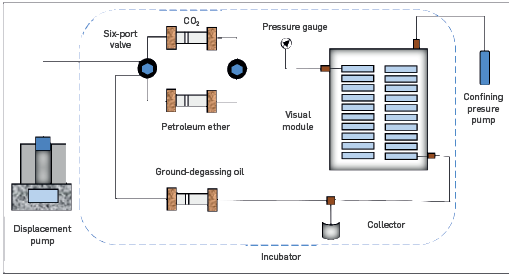
The experimental equipment is a jointly developed CO2 miscible visual flooding experimental device shown in Figure 1, including a visual slim tube (two front and rear transparent visual windows), and a sealed container surrounding it. Images and experimental data use a camera pan-tilt and computer software tracking system to complete image shooting and data collection. The backlight adopts a special lighting set for photography, with adjustable brightness and soft light. The experimental fluid is ground-degassing oil with a density of 0.77 g/cm3 and a viscosity of 12.54 mPa.s. The purity of CO2 used in the experiment is 99.9%. The experimental temperature is 40 °C, and CO2 is in supercritical state under 10 MPa and/or 15 MPa.
METHODS AND STEPS
① Set the temperature of the incubator at 40 °C, clean the visible slim tube and related tubes with petroleum ether, and dry them with CO2. ② Inject ground-degassing oil from the output end of the visual module to the injection end, and adjust the experimental pressure (10 MPa or 15 MPa). ③ Open the CO2 valve from the injection end of the visual module, and carry out the oil displacement experiment. ④ Adjust the injection flow rate (1.5 cm/min, 15 cm/min or 100 cm/min), and maintain constant pressure. ⑤ Observe the experimental phenomena and record the relevant data. ⑥ Discharge the fluid in the visual slim tube and repeat steps ①~⑤.
3 RESULTS
PRESSURE 10 MPa
FLOW RATE 1.5 cm/min
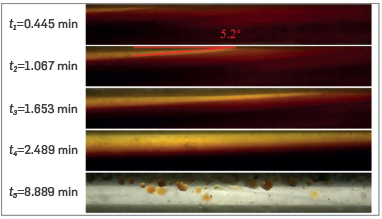
As shown in Figure 2, when the flow rate of CO2 and crude oil is 1.5 cm/min, it can be observed that there is a certain contact angle (5.2°) between the two phases of CO2 and crude oil that is small. Throughout the flow process, the contact surface characteristics between CO2 and crude oil are evident, with relatively moderate changes. As time passes, the color of CO2 in the upper part of the visible slim tube becomes light brownish red and the content gradually increases. The color of the crude oil in the lower part becomes lighter and the content gradually decreases. At t4=2.489 min, CO2 occupies the upper half of the visible slim tube, and crude oil occupies the lower half of the visible slim tube, with a distribution of the two in half. With the flow of CO2, the amount of crude oil at the bottom decreases until it is depleted. After a long time, there is condensation of light to medium hydrocarbon components on the inner wall of the tube, with a large quantity but small individual content, appearing as small dot-like formations.
FLOW RATE 15 cm/min
Figure 3 shows that CO2 and crude oil have a large contact angle (7.9°) that changes significantly at a flow rate of 15 cm/min. The change characteristics of the contact surface between CO2 and crude oil are apparent, and the increase rate of CO2 content in the upper part and the decrease rate of crude oil content in the lower part are greater. At t4=0.356 min, CO2 occupies a significant portion of the visible slim tube of about 4/5, while crude oil occupies a fraction of the visible slim tube of about 1/5. After a long time conducting the experiment, light and medium hydrocarbon components are condensed on the inner wall of the tube, and the quantities are minor. The individual content is large, and the individual appears in the shape of large speckles.
FLOW RATE 100 cm/min
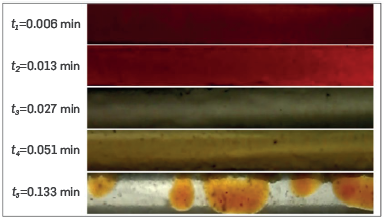
As shown in Figure 4, CO2 and crude oil phases have no contact angle at a high flow rate (100 cm/min). At t1=0.006 min, the crude oil appears with a deep reddish-brown color, without CO2. At t2=0.013 min, the crude oil has a reddish-brown color with a small amount of CO2. At t3=0.027 min, it is dark gray CO2 containing a significant quantity of light and medium hydrocarbon components. At t4=0.051 min, yellow-gray CO2 contains a small amount of light and medium hydrocarbon components. At t5=0.133 min, it is large circular speckles of light and medium hydrocarbon components condensed out.
PRESSURE 15 MPa
FLOW RATE 1.5 cm/min
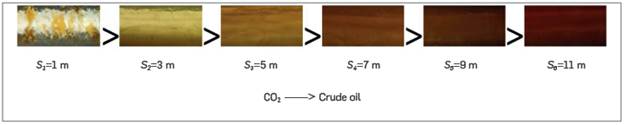
Under the pressure condition of 15 MPa, the experiment of CO2 displacement of crude oil is conducted at the flow rate of 1.5 cm/ min. It is noticed that during the flow process, no contact inclination is seen between the two phases of CO2 and crude oil (no contact angle variation characteristics), but there is a transition interval between CO2 and crude oil (Figure 5). From the injection end to the output end, the order of transition intervals observed is ® CO2 interval containing small speckles of light and medium hydrocarbon components, ② CO2 interval containing a small amount of light and medium hydrocarbon components, ③ CO2 interval containing a large amount of light and medium hydrocarbon components, ④ intermediate interval where CO2 and crude oil are mixed, ⑤ crude oil interval containing a large amount of CO2, ⑥ crude oil interval containing a small amount of CO2. In the transition interval, black stripes can be observed. In the experiment, the direction of fluid flow and black stripes are both from left to right, and the inclination angle (20°) of black stripes is downwards and relatively small. 3.2.2. Flow Rate 15 cm/min Figure 6 shows that the transition interval between CO2 and crude oil is observed in the flow process at the flow rate of 15 cm/min. Different from the flow rate of 1.5 cm/min experiment, the leftmost side of the transition interval is the CO2 interval containing large speckles of light and medium hydrocarbon components. The direction of the black stripes appears from left to right, and the dip angle (65°) is downwards and large.
FLOW RATE 100 cm/min
As shown in Figure 7, in the 15 MPa and 100 cm/min displacement experiments, the transition interval between CO2 and crude oil can also be observed. The difference from the above experiments is that the leftmost side of the transition interval is the CO2 interval containing the light and medium hydrocarbon components of the large circular speckles. The direction of the black stripes is from left to right and evenly distributed horizontally.
4 RESULTS ANALYSIS
PRESSURE 10 MPa
During the 10 MPa experiments, at flow rates of 1.5 cm/min and 15 cm/min, a distinct contact angle between CO2 and crude oil is observed, and the angle is different (Table 1). The stratification of CO2 and crude oil occurs during the flow process, meaning that the experiment is an immiscible experiment. Due to the influence of gravity differences, stratification occurs between CO2 and crude oil, which forms a fingering phenomenon in a visible slim tube and forms a certain contact angle. The greater flow rate of the experimental fluid, the larger the contact angle. Specifically, the contact angle changes from 5.2° to 7.9° when the fluid flow rate changes from 1.5 cm/min to 15 cm/min.
In the experiments with the flow rate of 1.5 cm/min and 15 cm/ min, due to the extraction of crude oil by CO2, the light and medium hydrocarbon components in the crude oil are extracted into the CO2, resulting in a light brownish-red color of the CO2. In the experiment with the flow rate of 100 cm/min, due to the high fluid flow rate, the color of CO2 containing a large amount of light and medium hydrocarbon components is dark gray, while when containing a small amount of light and medium hydrocarbon components it is yellow-gray. The color of CO2 is grayish due to the low transmittance of light when it passes through high-speed fluids.
In the later stages of the experiments with different flow rates, the quantity, individual content, and shape of the light and medium hydrocarbon components condensed on the inner wall of the visible slim tube are different. This is because different fluid flow rates have a certain effect on the extraction of CO2. At low flow rates, the contact area between CO2 and crude oil changes little, and the degree of CO2 diffusion into crude oil is limited, resulting in poor dissolution and mass transfer between CO2 and crude oil, and the extraction effect is weak. At high flow rates, the contact area between CO2 and crude oil changes greatly, and the degree of CO2 diffusion into the crude oil increases, which makes the dissolution and mass transfer between CO2 and crude oil better and the extraction effect stronger.
PRESSURE 15 MPa
Under the experimental pressure of 15 MPa, the transitional interval between CO2 and crude oil can be observed in the displacement process with different flow rates, meaningthat the experiment is CO2 miscible flooding. The experiment confirms that the miscibility is a dynamic process, with different fluid properties and phase intervals. Each interval is variable and forward, allowing to visualize the transitional interval between CO2 and crude oil.
In the experiment of visual slim tube, the whole transition interval is divided into 6 intervals, based on the difference of fluid color, shape and phenomenon. In fact, the whole transition interval is uniform and continuous, and it is difficult to divide it finely at present. The slim tube used in this experiment is not a porous medium, so the miscible transition interval of CO2 and crude oil cannot fully represent the variation characteristics in a porous medium, but it has some indicative significance.
During the experiment of different flow rates, in addition to the different morphology and distribution of condensate droplets on the tube wall, black stripes appear in the transition interval, and their inclination angles and distribution are different. When the flow rates are 1.5 cm/min and 15 cm/min, the dip angle of black stripes is small. The diffusion and mass transfer of C02 in crude oil are weak, and the transition interval is short. When the flow rate is 100 cm/min, the black stripes are evenly distributed horizontally. The diffusion and mass transfer of C02 in crude oil are strong, and the transition interval is long.
CHARACTERISTIC ANALYSIS
Compared to vertical static experiments, horizontal dynamic experiments show that under immiscible conditions, due to the gravity difference, C02 and crude oil are stratified during the flow process, resulting in fingering. In actual reservoir development, C02 breakthrough occurs in the production wells, and gas kick is formed prematurely. During the experiments, the fluid flow rates are different. Under the immiscible flooding, the contact angle between C02 and crude oil is different and the breakthrough time of C02 after gas injection is different. Under the miscible condition, the length of the transition interval between C02 and crude oil and the increase in reservoir production are different. Under the condition of 15 MPa, CO2 and crude oil are miscible, and a transition interval of fluid from CO2 component to crude oil component is formed, which is divided into 6 intervals.
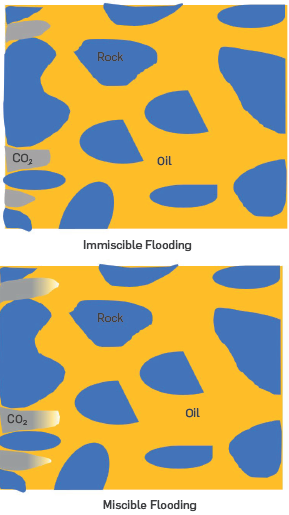
Furthermore, there is an interphase mass transfer between CO2 and crude oil, reducing the interfacial tension, thus effectively promoting sweep efficiency. When the injection pressure reaches the maximum value of 15 MPa, the displacement efficiency factor is further increased. The microscopic mechanism involved in CO2 flooding is illustrated in Figure 8.
APPLICATION ANALYSIS
Studying the visualization characteristics of CO2 miscibility can enhance our understanding of the various factors influencing miscibility during the CO2 flooding process (Liu, X. et al., 2024Liu, X., Chen, H., Cheng, W., Xu, C., Zuo, M., Gao, S. , ... & Brahim, M. S. (2024, April). The Effect of Different Miscible Degrees on the Migration of Diversified Phase Zones in the Tight Reservoir. In SPE EOR Conference at Oil and Gas West Asia (p. D021S019R006). SPE. https://doi.org/10.2118/218490-MS
https://doi.org/10.2118/218490-MS...
; Song et al., 2022Song, Y., Song, Z., Zeng, H., Tai, C., & Chang, X. (2022). N2 and CO2 Huff-n-Puff for Enhanced Tight Oil Recovery: An Experimental Study Using Nuclear Magnetic Resonance. Energy & Fuels, 36(3), 1515-1521. https://doi.org/10.1021/acs.energyfuels.1c03982
https://doi.org/10.1021/acs.energyfuels....
). These factors include experimental pressure and fluid flow rate. By controlling and adjusting these factors, the CO2 flooding process is optimized to enhance oil recovery. Moreover, in the actual production process, the injection rate and injection pressure of CO2 are adjusted according to the miscible visualization characteristics of CO2 to achieve the best results.
Studies have explored the adaptability and application prospects of CO2 in various reservoir types, including light oil reservoirs, low permeability reservoirs, and shale reservoirs (Hou et al., 2023Hou, Z.-M., Xiong, Y., Luo, J.-S., Fang, Y.-L., Haris, M., Chen, Q.-J., . . . Huang, L.-C. (2023). International experience of carbon neutrality and prospects of key technologies: Lessons for China. Petroleum Science, 20(2). 893-909. https://doi.org/10.1016/j.petsci.2023.02.018
https://doi.org/10.1016/j.petsci.2023.02...
; Mahdaviara et al., 2022Mahdaviara, M., Sharifi, M., & Ahmadi, M. (2022). Toward evaluation and screening of the enhanced oil recovery scenarios for low permeability reservoirs using statistical and machine learning techniques. Fuel, 325, 124795. https://doi.org/10.1016/j.fuel.2022.124795
https://doi.org/10.1016/j.fuel.2022.1247...
; Pal et al., 2022Pal, N., Zhang, X., Ali, M., Mandal, A., & Hoteit, H. (2022). Carbon dioxide thickening: a review of technological aspects, advances and challenges for oilfield application. Fuel, 315, 122947. https://doi.org/10.1016/j.fuel.2021.122947
https://doi.org/10.1016/j.fuel.2021.1229...
). By observing the miscible characteristics of CO2 and different quality crude oils in different pore structures, the effect and potential of CO2 displacement in different reservoirs can be evaluated, and the synergistic utilization of CO2 displacement and storage can be explored. For example, in light oil reservoirs, higher flow rate and pressure are used to improve the dissolution and mass transfer between CO2 and crude oil to improve oil recovery. According to pilot test findings from the Yaoyingtai Oilfield in Northeast China, the cumulative injection volume of CO2 reached 22.6x10⁴ t, yielding effectiveness in 29 corresponding wells. This endeavor resulted in a cumulative oil increase of 1.8x10⁴ t, c recovery rate of 1.1%, with a CO2 storage efficiency reaching 92.6% (Zhang et al., 2024Zhang, L. , Tan, X. , Tian, X. , Jiao, Y. , Zhang, W. , Shu, X.....& Chen, H. (2024). Inspirations from Field-Reservoir CO2 Flooding with Different Miscible Degrees under Cross-Scale Oil Reservoir Conditions. ACS omega, 9(13), 1469214703. https://doi.org/10.1021/acsomega.3c08433
https://doi.org/10.1021/acsomega.3c08433...
). Notably, the success rate of CO2 miscible flooding projects remains notably high, evidenced by 104 successful projects in the U.S., constituting 81.2% of the total.
CO2 miscibility visualization technology can study various influencing factors in the process of CO2 displacement, such as impurity gas mixing, water shield barrier and pore size effect, as well as their influence mechanisms and laws on miscibility characteristics and displacement effects (Guo et al., 2022Guo, Y., Liu, F., Qiu, J., Xu, Z., & Bao, B. (2022). Microscopic transport and phase behaviors of CO2 injection in heterogeneous formations using microfluidics. Energy, 256, 124524. https://doi.org/10.1016/j.energy.2022.124524
https://doi.org/10.1016/j.energy.2022.12...
; Lei et al., 2022Lei, Z., Liu, Y., Wang, R., Li, L., Liu, Y., & Zhang, Y. (2022). A Microfluidic Experiment on CO2 Injection for Enhanced Oil Recovery in a Shale Oil Reservoir with High Temperature and Pressure. Energies, 15(24), 9461. https://doi.org/10.3390/en15249461
https://doi.org/10.3390/en15249461...
). By observing the concentration change of CO2 in the produced gas under the condition of impure CO2 gas, the separation effect of water shield on the oil and gas system, and the influence of pore size on the degree of miscibility, the key scientific and engineering problems in the promotion and application of CO2 miscible flooding technology can be better solved (Jin et al., 2023Jin, Y., Wang, Z., Zhang, Z., Lin, B., Ge, Z., You, Q., . . . Gao, S. (2023). The characteristics of CO2 front dynamic migration in low permeability sandstone oil reservoirs under different miscibility degrees. Geosystem Engineering, 1-10. https://doi.org/10.1080/12269328.2023.2199745
https://doi.org/10.1080/12269328.2023.21...
; Ma et al., 2022Ma, N., Li, C Wang, F., Liu, Z., Zhang, Y., Jiang, L., . . . Du, D. J. A. o. (2022). Laboratory study on the oil displacement process in low-permeability cores with different injection fluids. ACS Omega, 7(9), 8013-8022. https://doi.org/10.1021/acsomega.1c07165
https://doi.org/10.1021/acsomega.1c07165...
).
In addition, CO2 visualization research is of great significance to the energy transition. In 2022, 30 global CCUS projects will collectively store 297.6x10⁶t CO2. Among these, CO2 geological storage stands out as a crucial component.(Chen et al., 2024Chen, X., Zhang, Q., Li, Y., Liu, J., Liu, Z., & Liu, S. (2024). Investigation on enhanced oil recovery and CO2 storage efficiency of temperature-resistant CO2 foam flooding. Fuel, 364, 130870. https://doi.org/10.1016/j.fuel.2024.130870
https://doi.org/10.1016/j.fuel.2024.1308...
) CO2-enhanced oil and gas recovery technology can store approximately 14.1x10⁸t CO2, while depleted gas reservoirs offer a capacity of about 15.3x10t. Notably, the CO2-EOR technology in Shengli Oilfield is poised to increase oil production by 127 million tons while sequestering 204 x108t CO2.
CONCLUSIONS
o The CO2 miscible visual flooding experimental device is used to conduct the horizontal dynamic experiment in the visual slim tube. The experimental phenomena are observed and described by changing the experimental pressure and fluid flow rate. Analysis of the horizontal contact and dynamic change characteristics of CO2 and crude oil confirms that the main factors affecting the miscible characteristics of CO2 and crude oil are experimental pressure and fluid flow rate.
o In the 10 MPa experiments, the stratification phenomenon occurred, which is the immiscible displacement experiment of CO2 and crude oil. The larger the fluid flow rate (1.5 cm/min and 15 cm/min), the larger the contact angle between CO2 and crude oil becomes (5.2° and 7.9°). At a high fluid flow rate (100 cm/min), the color gray of CO2 intensifies. In the later stage of the experiment with different flow rates, the quantity, individual content, and shape of the light and medium hydrocarbon components condensed on the inner wall of the visible slim tube are different.
o In the 15 MPa experiments, using different flow rates, the transition interval between CO2 and crude oil appears in the displacement process, which is the miscible displacement experiment of CO2 and crude oil. It is confirmed that the existence of the miscible dynamic process makes the transition interval of CO2 and crude oil visualized. And the whole transition interval is divided into 6 intervals, which have certain indicative significance. In the experiment, the inclination angle and distribution of black stripes are different. The larger the fluid flow rate, the longer the transition interval.
ACKNOWLEDGEMENTS
This work is sponsored by Natural Science Foundation of Xinjiang Uygur Autonomous Region (No. 2021D01F38)
REFERENCES
- Brattekås, B., & Seright, R. (2023). A Review of Polymer Gel Utilization in Carbon Dioxide Flow Control at the Core and Field Scale. SPE Journal, 28(06), 3291-3307. https://doi.org/10.2118/217427-PA
» https://doi.org/10.2118/217427-PA - Chen, X., Zhang, Q., Li, Y., Liu, J., Liu, Z., & Liu, S. (2024). Investigation on enhanced oil recovery and CO2 storage efficiency of temperature-resistant CO2 foam flooding. Fuel, 364, 130870. https://doi.org/10.1016/j.fuel.2024.130870
» https://doi.org/10.1016/j.fuel.2024.130870 - Chen, Z., Su, Y.-L., Li, L., Meng, F.-K., & Zhou, X.-M. (2022). Characteristics and mechanisms of supercritical CO2 flooding under different factors in low-permeability reservoirs. Petroleum Science, 19(3), 1174-1184. https://doi.org/10.1016/j.petsci.2022.01.016
» https://doi.org/10.1016/j.petsci.2022.01.016 - Davoodi, S., Al-Shargabi, M., Wood, D. A., Mehrad, M., & Rukavishnikov, V. S. (2024). Carbon dioxide sequestration through enhanced oil recovery: A review of storage mechanisms and technological applications. Fuel, 366, 131313. https://doi.org/10.1016/j.fuel.2024.131313
» https://doi.org/10.1016/j.fuel.2024.131313 - Fu, H., Dang, S., Yang, K., Zhao, Y., Guo, C., Fu, H. ....& Song, K. (2023, March). Phase Field Simulation of Immiscible CO2 Flooding EOR Mechanisms in Porous Media. In SPE Gas & Oil Technology Showcase and Conference (p. D031S042R005). SPE. https://doi.org/10.2118/214217-MS
» https://doi.org/10.2118/214217-MS - Gallo, G., Puliti, R., Torres, R., & Erdmann-E, E. (2020). CO2 EOR with in-situ CO2 capture, a Neuquina basin oxycombustion case study. CT&F - Ciencia, Tecnología Y Futuro, 10(2), 39-47. https://doi.org/10.29047/01225383.250
» https://doi.org/10.29047/01225383.250 - Gao, X., Yang, S., Shen, B., Tian, L., Li, S., Zhang, X., & Wang, J. (2023). Influence of Reservoir Spatial Heterogeneity on a Multicoupling Process of CO2 Geological Storage. Energy & Fuels, 37(19), 14991-15005. https://doi.org/10.1021/acs.energyfuels.3c02784
» https://doi.org/10.1021/acs.energyfuels.3c02784 - Guo, Y., Liu, F., Qiu, J., Xu, Z., & Bao, B. (2022). Microscopic transport and phase behaviors of CO2 injection in heterogeneous formations using microfluidics. Energy, 256, 124524. https://doi.org/10.1016/j.energy.2022.124524
» https://doi.org/10.1016/j.energy.2022.124524 - Gür, T. M. (2022). Carbon Dioxide Emissions, Capture, Storage and Utilization: Review of Materials, Processes and Technologies. Progress in Energy and Combustion Science, 89, 100965. https://doi.org/10.1016/j.pecs.2021.100965
» https://doi.org/10.1016/j.pecs.2021.100965 - Hong, W. Y. (2022). A techno-economic review on carbon capture, utilisation and storage systems for achieving a net-zero CO2 emissions future. Carbon Capture Science Engineering & Technology, 3, 100044. https://doi.org/10.1016/j.ccst.2022.100044
» https://doi.org/10.1016/j.ccst.2022.100044 - Hou, Z.-M., Xiong, Y., Luo, J.-S., Fang, Y.-L., Haris, M., Chen, Q.-J., . . . Huang, L.-C. (2023). International experience of carbon neutrality and prospects of key technologies: Lessons for China. Petroleum Science, 20(2). 893-909. https://doi.org/10.1016/j.petsci.2023.02.018
» https://doi.org/10.1016/j.petsci.2023.02.018 - Huang, W., Xu, R., Zhang, F., Zou, Y., & Jiang, P. (2022). CO2 capture analysis in different combustion methods for CO2 utilisation and storage. International Journal of Oil, Gas Coal Technology, 29(3), 285-305. https://doi.org/10.1504/IJOGCT.2022.121048
» https://doi.org/10.1504/IJOGCT.2022.121048 - Jiang, S., Li, Y., Wang, F., Sun, H., Wang, H., & Yao, Z. (2022). A state-of-the-art review of CO2 enhanced oil recovery as a promising technology to achieve carbon neutrality in China. Environmental Research, 210, 112986. https://doi.org/10.1016/j.envres.2022.112986
» https://doi.org/10.1016/j.envres.2022.112986 - Jin, Y., Wang, Z., Zhang, Z., Lin, B., Ge, Z., You, Q., . . . Gao, S. (2023). The characteristics of CO2 front dynamic migration in low permeability sandstone oil reservoirs under different miscibility degrees. Geosystem Engineering, 1-10. https://doi.org/10.1080/12269328.2023.2199745
» https://doi.org/10.1080/12269328.2023.2199745 - Kumar, N., Augusto Sampaio, M., Ojha, K., Hoteit, H., & Mandal, A. (2022). Fundamental aspects, mechanisms and emerging possibilities of CO2 miscible flooding in enhanced oil recovery: A review. Fuel, 330, 125633. https://doi.org/10.1016/j.fuel.2022.125633
» https://doi.org/10.1016/j.fuel.2022.125633 - Lei, Z., Liu, Y., Wang, R., Li, L., Liu, Y., & Zhang, Y. (2022). A Microfluidic Experiment on CO2 Injection for Enhanced Oil Recovery in a Shale Oil Reservoir with High Temperature and Pressure. Energies, 15(24), 9461. https://doi.org/10.3390/en15249461
» https://doi.org/10.3390/en15249461 - Li, L., Zhou, X., Su, Y., Xiao, P., Chen, Z., & Zheng, J. (2022). Influence of Heterogeneity and Fracture Conductivity on Supercritical CO2 Miscible Flooding Enhancing Oil Recovery and Gas Channeling in Tight Oil Reservoirs. Energy & Fuels, 36(15), 8199-8209. https://doi.org/10.1021/acs.energyfuels.2c01587
» https://doi.org/10.1021/acs.energyfuels.2c01587 - Lin, Z., Lu, X., Wang, X., Chang, Y., Kang, K., & Zeng, F. (2024). Effect of N2 impurity on CO2-based cyclic solvent injection process in enhancing heavy oil recovery and CO2 storage. Energy, 290, 130227. https://doi.org/10.1016/jenergy.2023.130227
» https://doi.org/10.1016/jenergy.2023.130227 - Liu, J., Li, H., Liu, S., Xu, J., Wang, X., & Tan, Q. (2023). Investigating the Impact of Aqueous Phase on CO2 Huff 'n' Puff in Tight Oil Reservoirs Using Nuclear Magnetic Resonance Technology: Stimulation Measures and Mechanisms. SPE Journal, 1-17. https://doi.org/10.2118/217978-PA
» https://doi.org/10.2118/217978-PA - Liu, X., Chen, H., Cheng, W., Xu, C., Zuo, M., Gao, S. , ... & Brahim, M. S. (2024, April). The Effect of Different Miscible Degrees on the Migration of Diversified Phase Zones in the Tight Reservoir. In SPE EOR Conference at Oil and Gas West Asia (p. D021S019R006). SPE. https://doi.org/10.2118/218490-MS
» https://doi.org/10.2118/218490-MS - Liu, Y., Rui, Z., Yang, T., & Dindoruk, B. (2022). Using propanol as an additive to CO2 for improving CO2 utilization and storage in oil reservoirs. Applied Energy, 311, 118640. https://doi.org/10.1016/j.apenergy.2022.118640
» https://doi.org/10.1016/j.apenergy.2022.118640 - Ma, N., Li, C Wang, F., Liu, Z., Zhang, Y., Jiang, L., . . . Du, D. J. A. o. (2022). Laboratory study on the oil displacement process in low-permeability cores with different injection fluids. ACS Omega, 7(9), 8013-8022. https://doi.org/10.1021/acsomega.1c07165
» https://doi.org/10.1021/acsomega.1c07165 - Mahdaviara, M., Sharifi, M., & Ahmadi, M. (2022). Toward evaluation and screening of the enhanced oil recovery scenarios for low permeability reservoirs using statistical and machine learning techniques. Fuel, 325, 124795. https://doi.org/10.1016/j.fuel.2022.124795
» https://doi.org/10.1016/j.fuel.2022.124795 - Manigandan, P., Alam, M. S., Alagirisamy, K., Pachiyappan, D., Murshed, M., & Mahmood, H. (2023). Realizing the Sustainable Development Goals through technological innovation: juxtaposing the economic and environmental effects of financial development and energy use. Environmental Science and Pollution Research, 30(3), 8239-8256. https://doi.org/10.1007/s11356-022-22692-8
» https://doi.org/10.1007/s11356-022-22692-8 - Mirazimi, S., Olsen, D., Stenby, E. H., & Yan, W. (2022, June). Immiscible and Near-Miscible Gas Flooding in Tight Chalk: Laboratory Experiments and Compositional Simulation. In SPE Europec featured at EAGE Conference and Exhibition? (p. D041S013R004). SPE. https://doi.org/10.2118/209683-MS
» https://doi.org/10.2118/209683-MS - Pal, N., Zhang, X., Ali, M., Mandal, A., & Hoteit, H. (2022). Carbon dioxide thickening: a review of technological aspects, advances and challenges for oilfield application. Fuel, 315, 122947. https://doi.org/10.1016/j.fuel.2021.122947
» https://doi.org/10.1016/j.fuel.2021.122947 - Prakash, S., Joshi, D., Ojha, K., & Mandal, A. (2024). Enhanced Oil Recovery Using Polymer Alternating CO2 Gas Injection: Mechanisms, Efficiency, and Environmental Benefits. Energy & Fuels, 38(7). 5676-5689. https://doi.org/10.1021/acs.energyfuels.3c04258
» https://doi.org/10.1021/acs.energyfuels.3c04258 - Raihan, A., Muhtasim, D. A., Farhana, S., Pavel, M. I., Faruk, O., Rahman, M., & Mahmood, A. (2022). Nexus between carbon emissions, economic growth, renewable energy use, urbanization, industrialization, technological innovation, and forest area towards achieving environmental sustainability in Bangladesh. Energy and Climate Change, 3, 100080. https://doi.org/10.1016/j.egycc.2022.100080
» https://doi.org/10.1016/j.egycc.2022.100080 - Shen, M., Tong, L., Yin, S., Liu, C., Wang, L., Feng, W., & Ding, Y. (2022). Cryogenic technology progress for CO2 capture under carbon neutrality goals: A review. Separation and Purification Technology, 299, 121734. https://doi.org/10.1016/j.seppur.2022.121734
» https://doi.org/10.1016/j.seppur.2022.121734 - Song, Y., Song, Z., Zeng, H., Tai, C., & Chang, X. (2022). N2 and CO2 Huff-n-Puff for Enhanced Tight Oil Recovery: An Experimental Study Using Nuclear Magnetic Resonance. Energy & Fuels, 36(3), 1515-1521. https://doi.org/10.1021/acs.energyfuels.1c03982
» https://doi.org/10.1021/acs.energyfuels.1c03982 - Tan, Y., Li, Q., Xu, L., Ghaffar, A., Zhou, X., & Li, P. (2022). A critical review of carbon dioxide enhanced oil recovery in carbonate reservoirs. Fuel, 328, 125256. https://doi.org/10.1016/j.fuel.2022.125256
» https://doi.org/10.1016/j.fuel.2022.125256 - Wang, H., Tian, L., Chai, X., Wang, J., & Zhang, K. (2022). Effect of pore structure on recovery of CO2 miscible flooding efficiency in low permeability reservoirs. Journal of Petroleum Science and Engineering, 208, 109305. https://doi.org/10.1016/j.petrol.2021.109305
» https://doi.org/10.1016/j.petrol.2021.109305 - Xiao, W., Yang, Y., Bernabé, Y., Lei, Q., Li, M., Xie, Q.....Ren, J. (2023). Experimental Study on EOR in Shale Oil Cores during Associated Gasflooding: A Case Study from Yanchang Formation, Ordos Basin. SPE Journal, 28(05), 2329-2345. https://doi.org/10.2118/214704-PA
» https://doi.org/10.2118/214704-PA - Yang, R., Zhang, L., Tan, X., Tian, X., Jiao, Y., Zhang, W., . . . Chen, H. (2024). Study on Different Miscibility Intervals of an Impure CO2-Crude Oil System in Offshore Low-Permeability Reservoirs. Energy & Fuels, 38(2), 10101018. https://doi.org/10.1021/acs.energyfuels.3c03884
» https://doi.org/10.1021/acs.energyfuels.3c03884 - Yi, X., Zhang, M., & Mu, G. (2023). Microscopic Distribution and Development Strategy of Residual Oil in Tight Sandstone. Processes, 11(7), 1907. https://doi.org/10.3390/pr11071907
» https://doi.org/10.3390/pr11071907 - Zhang, L. , Tan, X. , Tian, X. , Jiao, Y. , Zhang, W. , Shu, X.....& Chen, H. (2024). Inspirations from Field-Reservoir CO2 Flooding with Different Miscible Degrees under Cross-Scale Oil Reservoir Conditions. ACS omega, 9(13), 1469214703. https://doi.org/10.1021/acsomega.3c08433
» https://doi.org/10.1021/acsomega.3c08433
AUTHORS
| Author | Affiliation | ROR | ORCID | |
|---|---|---|---|---|
| Xing Zhang | China University of Petroleum (Beijing) at Karamay |

|
0009-0001-4897-5996 | zhangxing@cupk.edu.cn |
| Dongchen Ma | SINOPEC – Northwest Oilfield Company |
|
0009-0005-4537-3104 | 1135048526@qq.com |
| Ruiming Zhao | SINOPEC – Northwest Oilfield Company |
|
0009-0002-5272-6340 | 1460377568@qq.com |
| Xiaoyu Zhang | SINOPEC – Northwest Oilfield Company |
|
0009-0007-5309-8645 | 1374494284@qq.com |
| Jiajia Feng | PetroChina – West Drilling Engineering Co., Ltd. |
|
0009-0000-7874-864X | 2941836725@qq.com |
| Meng Feng | PetroChina – West Drilling Engineering Co., Ltd. |
|
0009-0006-5208-0788 | 508565332@qq.com |
| Jin Zhang | China University of Petroleum (Beijing) at Karamay |
|
0009-0005-8178-9721 | 15085514022@163.com |
-
How to cite:
How to cite: Zhang, et al., (2024). Experimental study on immiscible and miscible dynamic characteristics of CO2 and crude oil in visual slim tube. Ciencia, Tecnología y Futuro - CT&F, Vol. 14(1). 5-12
Publication Dates
-
Date of issue
Jan-Jun 2024
History
-
Received
08 Mar 2024 -
Reviewed
07 May 2024 -
Accepted
15 May 2024